Challenges in c-level recruitment
16 maja 2026
8 min czytania

Hiring a C-level leader is one of the key decisions that truly defines a company’s future. It’s not just about filling a vacancy; it’s a strategic move that impacts the entire organization. From my experience, I know that traditional recruitment methods simply fail in this segment. We need an approach that goes beyond job ads and is built on relationships.
Recruiting for top management positions is a high-stakes game. A wrong choice leads to serious financial losses and a loss of stakeholder trust. The negative effects can be felt for years. We’re talking about sums that can run into the millions if a new leader fails to deliver expected results or, worse, damages the company’s reputation.
The pool of candidates with unique competencies and the right experience is severely limited. The best leaders are typically passive candidates – they aren’t actively looking for work and don’t respond to public job postings. This is why standard recruitment methods prove ineffective. The process itself is lengthy; it often takes 4 to 6 months before a new board member joins the company.
Why a proactive approach is a necessity
This is why a proactive approach isn’t an option, but a necessity. Proactive talent mapping gives us knowledge of potential leaders, key players, and their financial expectations before a vacancy even opens up. This minimizes the risk of reactive hiring under time pressure.
Building relationships with potential leaders long before a recruitment need arises allows for thorough verification and cultural assessment. A leader who doesn’t fit the management team’s dynamic won’t succeed, even with strong technical skills. Our goal is to hire people who not only have the skills but will also enrich the organization and co-create its future.
Strategic talent mapping: The foundation of success
What talent mapping is and how to implement it
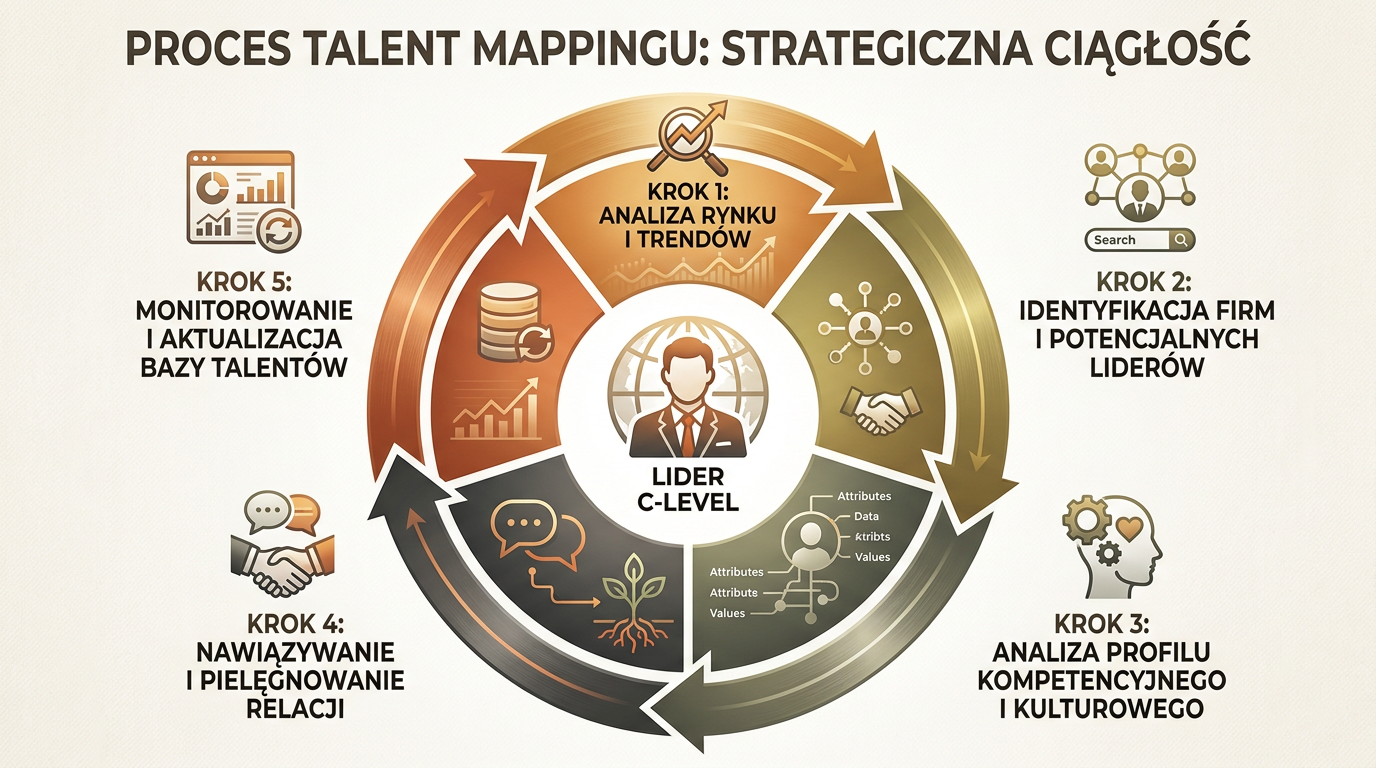
Talent mapping isn’t a one-off activity but a continuous process of identifying and monitoring top leaders in the market. It’s a strategic tool that helps build a long-term competitive advantage. It gives us insight into candidate availability, competitor structures, and potential gaps in succession plans.
The talent mapping process includes several key steps:
- Market and trend analysis: We understand which competencies will be crucial in the future and where to find such talent in the market.
- Identifying companies and potential leaders: We look for organizations that are talent factories in a given industry.
- Competency and cultural profile analysis: We examine the achievements, management style, and values of potential candidates in detail.
- Establishing and nurturing relationships: We build a network of contacts, which I’ll discuss more in a moment.
- Monitoring and updating the talent pool: The market is dynamic, so the database must be a living, constantly updated resource.
We are supported in this by tools like a recruitment CRM, specialized databases, and, above all, social media – especially LinkedIn.
Identifying key competencies and organizational culture
In C-level recruitment, we don’t just look at hard skills – financial results or experience managing large teams. Soft skills are equally important: strategic vision, adaptability, emotional intelligence, leadership, and the ability to inspire.
Cultural add is key, not just a cultural fit. We look for leaders who will enrich our culture, bring fresh perspectives, and add diversity, rather than just fitting perfectly into the existing framework. Homogeneity on the board rarely leads to innovation. The board must precisely define the ideal candidate profile, considering hard requirements, values, and the company’s mission. After all, they know best who they need.
Steps to effective c-level recruitment
Building long-term relationships with leaders
Top leaders rarely respond to job ads. We have to find them and connect with them. This requires strategic networking. Attending industry conferences, panel discussions, or private events is fundamental. But it’s not enough.
A recruiter must build a personal brand – establishing themselves as an expert and trusted advisor, not just a headhunter. It’s about offering added value: sharing market insights, inviting them to discussions, and sometimes even offering mentorship. This builds trust and opens doors to conversations that go beyond the typical “are you looking for a job?”
Multi-dimensional candidate assessment: Beyond the resume
A resume is just a starting point, never the whole story. For C-level recruitment, we need a multi-dimensional assessment:
- Assessment centers and business simulations allow us to test skills in practical scenarios. We see how a candidate reacts under pressure, makes decisions, and collaborates.
- Behavioral and competency-based interviews focus on past behavior as a predictor of future performance. We ask about specific situations, challenges, and how they were resolved.
- 360-degree references involve gathering feedback from peers, subordinates, and superiors. This provides a more complete picture of the candidate’s management style and real impact.
Using specialized executive search firms is standard practice. They have extensive networks and in-depth market knowledge, which speeds up the process and minimizes risk.
The role of employer branding in attracting top talent
A strong employer brand is a magnet for top talent. We must communicate the company’s values and mission consistently and authentically. C-level leaders are looking for more than just a high salary. For them, a real impact on company strategy, decision-making autonomy, development opportunities, and alignment with personal values are equally important.
The EVP (Employee Value Proposition) must be tailored to the needs of the C-level: challenges, impact, autonomy, growth. Actively using LinkedIn to showcase the company’s culture, achievements, and vision is essential today.
Finalization and onboarding: The key to integration
Negotiating the compensation and benefits package requires flexibility and an understanding of the leader’s individual needs. It’s not just about the salary, but also stock options, health packages, or development opportunities.
After the contract is signed, onboarding is crucial. Clearly defining expectations and goals for the first 90 days is an absolute must. The new leader needs to know what they are expected to achieve and how their success will be measured. Support from the board and mentorship will facilitate integration into the new role and organizational culture. A new CEO cannot feel isolated.
Tips and pitfalls to avoid
How to maintain a c-level network
Building a network is one thing, maintaining it is another. Contact must be regular and valuable – not just when you need to fill a role. Sharing knowledge, market insights, or inviting collaboration on joint projects or panels – this is what builds real relationships.
Personalizing communication is key. Avoid mass messages. Focus on the individual interests and needs of each contact. Remember: it’s about relationships, not a database.
Pitfalls in assessing cultural fit
Assessing cultural fit is often a subjective trap. Recruiters can fall prey to biases, looking for “clones” instead of diversity. This leads to homogeneity on the board and a lack of innovation.
The key is a clearly defined organizational culture. Without it, it’s difficult to objectively assess whether a candidate will add value. We should use objective criteria and tools that minimize the risk of a bad call.
FAQ: Frequently asked questions
When should you start talent mapping?
Talent mapping is a continuous process. It’s best to start before a specific vacancy appears. It should be part of the organization’s strategic succession planning. Ideally, start building a C-level talent pool 6-12 months before an anticipated need. This gives you time to establish relationships.
How to measure the effectiveness of a proactive recruitment strategy?
We measure the effectiveness of proactive recruitment using several key metrics:
- Time to Hire: Shortening the time from when a vacancy opens to when it’s filled, thanks to a ready pool of candidates.
- Quality of Hire: Retention, performance in the first 12 months, cultural fit, and the new leader’s real impact on company goals.
- Cost per Hire: Potentially lowering fees for external agencies, thanks to an internal talent pool.
Key takeaways
| Metric | Traditional Recruitment | Proactive Recruitment | Metric Goal |
|---|---|---|---|
| Time to hire | Long, often > 90 days | Short, often < 60 days | Speed of filling positions |
| Candidate quality | Assessment after hiring | High, strategic fit | Impact on company results |
| Cost of hiring | High (agencies, advertisements) | Lower (networking, branding) | Budget efficiency |
| Retention rate | Variable, risk of turnover | High, long-term commitment | Stability of managerial staff |
| Talent pool | Reactive, limited | Large, continuously built | Access to top candidates |
Effective C-level recruitment is a proactive process of building relationships and strategic talent mapping. There’s no room for reactive measures. A deep assessment of competencies and cultural add is more important than the resume alone. Your employer brand and the continuous nurturing of your network are the foundations of success.
The future of c-level recruitment
Looking ahead, I see the growing importance of AI and data analytics in identifying and profiling talent. Technology will help us find potential leaders faster. However, regardless of technological advancements, personalization and building authentic relationships will remain crucial. The job market is dynamic, so constantly adapting recruitment strategies is necessary. The leaders of the future will need not only hard skills but also the ability to manage change in a complex environment.